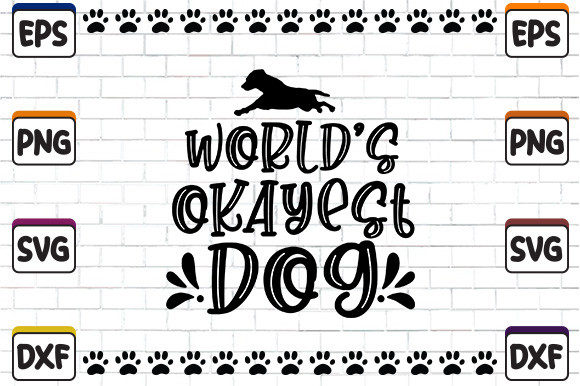
World’s Okayest Dog
A Designer’s Real-World Look Before Stitching
As someone who’s digitized, tested, and shipped hundreds of embroidery designs for clients—from Etsy sellers launching their first line to boutique owners refreshing seasonal merchandise—I opened World’s Okayest Dog expecting charm, not perfection. And that’s exactly what it delivers: warm, self-aware, gently imperfect energy. It’s the kind of design that lands on a baby onesie and makes parents chuckle mid-diaper change, or shows up on a linen tea towel and feels like an inside joke with your kitchen.
First Impression: Friendly, Flexible, and Fabric-Ready
The layout is clean and centered—no sprawling flourishes or tight clusters that beg for precise alignment. The lettering is rounded but legible, with subtle irregularity in stroke weight that reads as hand-drawn, not sloppy. There’s no dog illustration embedded—just the phrase—so it’s inherently adaptable: pair it with a simple bone icon you already own, stitch it solo on a curved cap brim, or layer it over a custom applique paw print. That simplicity is its strength. It doesn’t compete; it complements.
Where It Shines in Real Embroidery Projects
- Tote bags & canvas aprons: Works beautifully at 3.5"–4.5" wide. The moderate height-to-width ratio prevents awkward stretching across seams or gussets.
- Sweatshirts & hoodies: Holds up well on medium-weight fleece—especially when stitched with a light tear-away + cut-away hybrid stabilizer. No dense fill areas to cause puckering.
- Baby items (onesies, burp cloths, pillow covers): At 2.75", it reads clearly without overwhelming delicate scale. The open letterforms avoid tiny enclosed spaces where thread can nest or snag.
- Holiday & gift-ready pieces: Paired with neutral thread (heather gray, oatmeal, navy) on natural linen or organic cotton, it reads thoughtful—not trendy. Perfect for “new pet” gifts or “dog parent survival kits.”
- Etsy listings & small shop merch: As a standalone digital embroidery file, it’s low-risk inventory—you’re not buying physical stock, just adding a versatile, emotionally resonant option to your catalog.
Where to Pause—and Test First
This isn’t a “set-and-forget” design for every surface. Its friendly looseness means it needs thoughtful execution in certain contexts:
- Small hoops (under 3"): At under 2.5", letter spacing starts to feel cramped. Running stitch outlines may blur; test with reduced stitch density if shrinking.
- Stretchy fabrics (rib knits, lightweight jerseys): Requires excellent stabilization—floating stabilizer helps prevent distortion around curves. Skip the satin stitch border unless you’re confident in your tension calibration.
- Dark or textured fabrics (corduroy, terry cloth, heavy denim): Avoid ultra-fine thread (60wt). Stick with 40wt polyester for visibility and coverage. A white or cream thread pops cleanly—even on charcoal.
- Curved surfaces (caps, beanies): The phrase’s even baseline helps, but avoid placing it too close to the crown seam. Center it just above the front panel curve for natural drape.
- Frequent-wash items (kitchen towels, kids’ tees): Confirm your machine’s fill stitch density isn’t overly sparse—loose stitches can snag. A gentle zigzag or satin outline adds durability without fuss.
What It Adds to Your Finished Product—Beyond the Thread
World’s Okayest Dog elevates handmade perception—not by looking expensive, but by feeling *human*. Customers don’t buy perfect stitching; they buy recognition. That slight wobble in the “g” or the soft edge on the “W”? It signals care, not compromise. On a personalized gift, it reads as intentional warmth—not generic clip art. For craft businesses, it builds trust: you’re not selling mass-produced slogans; you’re offering wit with wearability.
It also supports brand consistency. Whether you use it on a holiday patch series or a year-round “Dog Mom Life” collection, its tone stays cohesive—never cutesy, never cynical. And because it’s delivered as SVG, DXF, EPS, and PNG, it bridges embroidery and print workflows seamlessly. Use the PNG for printable mockups on your Etsy listings; bring the SVG into your digitizing software to adjust spacing or add a subtle shadow stitch.
Practical Designer Notes—Before You Hoop Up
- Always stitch a test on scrap fabric—same type, same stabilizer, same thread brand—as your final project.
- Check contrast early: Try black thread on ecru linen and white thread on indigo denim in your design software preview. Does the phrase hold shape? Does kerning stay readable?
- Review stitch order: If digitizing yourself, lead with outlines, then fills—this keeps letter integrity sharp on uneven surfaces.
- Confirm licensing scope: Since this is a digital embroidery file sold for print (not physical goods), verify whether commercial use—like embroidering and reselling finished totes—is permitted. When in doubt, contact the seller.
- Use proper stabilizer for your fabric category: Lightweight cut-away for knits, tear-away for stable wovens, and fusible + tear-away combo for nap-heavy fabrics like fleece.
- Test both light and dark backgrounds in your mockup workflow—especially if you plan to offer multiple colorways in your shop.
Final Thought: A Quietly Confident Design Choice
You won’t find viral hype in World’s Okayest Dog. What you will find is reliability—the kind that comes from knowing exactly how a phrase breathes on fabric, how it lands with customers, and how it fits within a broader Crafts or Graphics toolkit without demanding attention. It’s not flashy. It’s functional, friendly, and quietly confident. And in the world of handmade product design—where authenticity sells faster than perfection—that’s more than okay. It’s exactly right.